




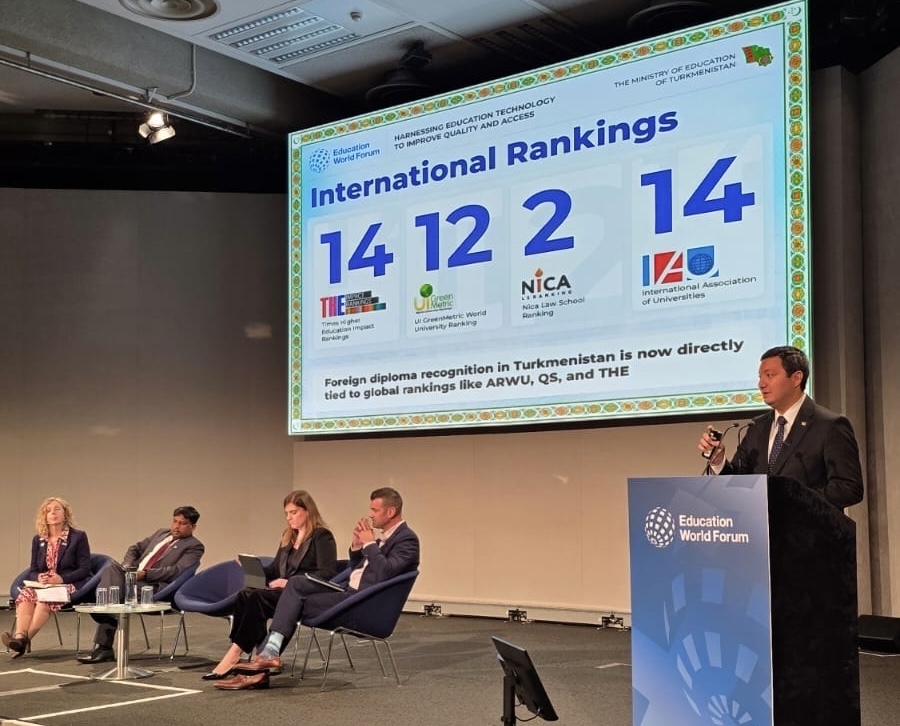
As part of the Education World Forum 2026, Deputy Minister of Education of Turkmenistan Azat Atayev participated as a speaker in the parallel session “Harnessing Education Technology to Improve Quality and Access”, dedicated to the use of educational technologies to improve quality, expand access, support educators, and ensure equal opportunities in education. The presentation highlighted the work being carried out in the education system of Turkmenistan under the wise leadership of the President of Turkmenistan Serdar Berdimuhamedov in the areas of digital transformation, improvement of education quality, and human capital development.
During the presentation, the Turkmen side emphasized that the real value of digitalisation lies in creating a more intelligent, transparent, and adaptive education system capable of addressing the needs of every learner, supporting teachers more effectively, and connecting education with the future needs of the economy.
Particular attention was given to the development of Turkmenistan’s digital educational architecture. Approaches to the use of the e-mekdep, men talyp, EMIS platforms and analytical tools were presented, enabling the analysis of attendance, academic performance, study workload, learning dynamics, individual learning pathways, and forecasting of graduate output.
The presentation also covered efforts aimed at developing individual educational trajectories for students. It was emphasized that a student’s academic results, attendance, interests, and grades — can be used to provide more objective recommendations for further education and career guidance, while preserving the decisive role of the student and their family.
Separate attention was given to the results of implementing a digital KPI system in higher education. Since 2021, Turkmenistan has been carrying out monitoring at the level of teachers, departments, faculties, and universities, including indicators related to publications, citations, h-index, patents, R&D income, implementation of research results into production, and innovation activity.
The Turkmen side stressed that education is viewed as a key infrastructure of the knowledge economy. In this regard, digital tools are used not only for managing schools and universities, but also for linking education with the labour market, forecasting workforce needs, developing the Atlas of Future Professions, and creating a unified educational portfolio of citizens.
Participants of the session expressed interest in Turkmenistan’s experience in integrating digital platforms, educational analytics, individual learning pathways, graduate data, and long-term human capital planning. It was noted that the presented approach reflects a systemic understanding of the role of technology in education: technology should not replace teachers, but rather strengthen their work, support learners, increase management transparency, and contribute to data-driven decision-making.
Participants of the session positively assessed the work being carried out in Turkmenistan on the digital transformation of education, the development of analytical tools, and the establishment of an evidence-based foundation for education quality management.