


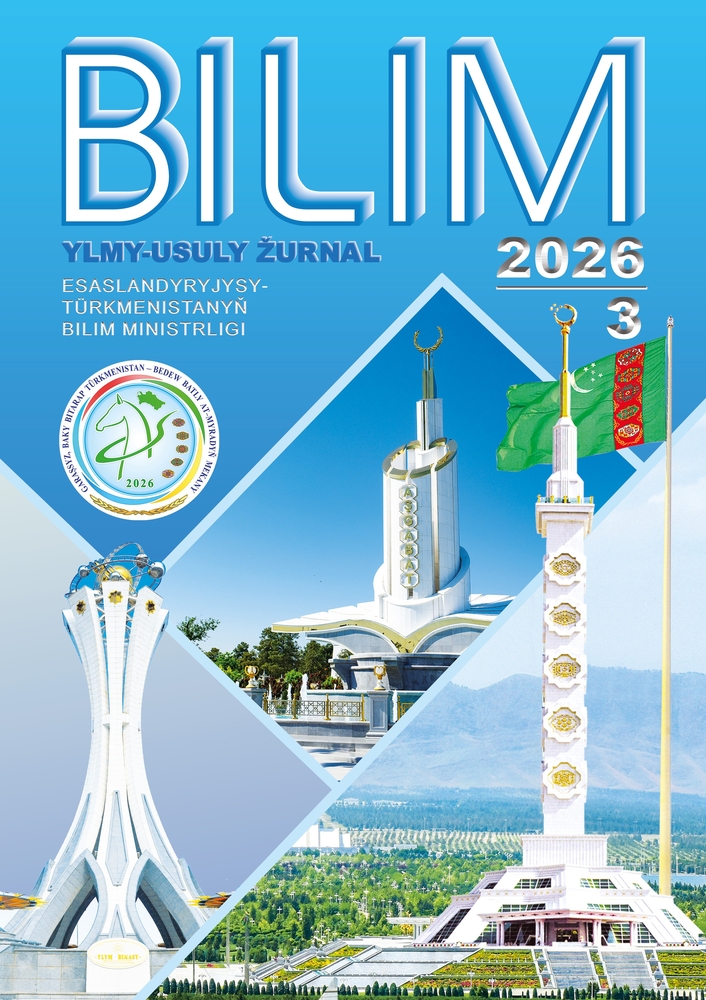
The new issue of the scientific-methodological magazine "Bilim" (Education) of the Ministry of Education of Turkmenistan has been published. This current 3rd issue of the magazine for the year 2026 opens with the section titled "Educational Policy of Our Country". The article titled "The Didactic Content of Glorious Dates as a Guide in Organizing Pedagogical Work," written in the spirit characteristic of the periodical press, aims to describe the broad meaning and essence of public events and celebrations held at the state level in May and June of the current year, and to promote the impact of such events on upbringing the young generation. It emphasizes that celebrations are organized at a high festive level in the capital and all corners of our country, which holds great significance for the organizational structure of the work of education professionals. In the same section, an article titled "A Great Victory Achieved at the International Olympiad" is featured. It provides interesting information and heartfelt expressions regarding the award ceremony held at the Ministry of Education of Turkmenistan on April 24 of this year to honor school students who won victories at the 60th International Mendeleev Chemistry Olympiad, organized by the Lomonosov Moscow State University of the Russian Federation between April 15 and 23, 2026.
It is well known that great attention is paid at the state level to the importance of international relations in developing the country's education system. In this regard, the published article titled "International Cooperation in Teacher Training: Joint Experience of Russia and Turkmenistan" is dedicated to the cooperation experience of the Naberezhnye Chelny State University of Tatarstan with educational institutions of Turkmenistan. It notes that during the period of cooperation since 2009, many Turkmen youths have received education at this school. The content of international experience and effective methodologies are described. The author of the article highlights that over 1,000 Turkmen youths received higher education at the said university during this period, a three-stage professional development program was developed with the participation of more than 700 Turkmen educators, joint textbooks and teaching manuals were prepared, 70 video lessons for the Russian language subject were created for 1st-grade students, and there are future plans to open a branch of Naberezhnye Chelny State University in Turkmenistan.
Following the political pages, extensive space is dedicated to scientific publications within the magazine. In the section titled "Scientific Articles," an article by the Minister of Education titled "Organization of Educational Work under the Seljuks" is placed, leading 13 articles presented in this category. The article emphasizes the concepts of education and upbringing put forward by Hero Arkadag and the honorable President, the successfully implemented educational reforms, and the fact that the education provided to the young generation originates from the ancient history of the Turkmen people, highlighting the continuity, integrity, national identity, and modernity of the pedagogical school, and its special service in ensuring the perpetuity of educational activities. Based on precise scientific data, the article describes the organization of education during the Seljuk period, underlining the significant role this experience plays in today's education by connecting the past, present, and future, as well as its importance in raising dedicated children of the Motherland whose hearts are filled with love and loyalty to their country and people.
In the article titled "The Role and Importance of Tests in Evaluating the Quality of Education Given to School Students," published in the scientific articles section, extensive coverage is given to information regarding the evaluation of students' learning, comparative results of participants in ongoing tests, and effective methods to develop students' independent work skills (which will be interesting for modern teachers).
The scientific article titled "Artistic Features of the Language of Hero Arkadag's Works" proudly highlights the high level of classical literary language traditions in the works of the National Leader of the Turkmen people, Hero Arkadag. The author specifically notes its harmony with the lexical richness of the modern Turkmen language. The author draws the readers' attention to the fact that the masterful use of metaphors and epithets in the works once again reveals the profound depth of Hero Arkadag's authorial philosophy.
The article titled "Information about Children in Mahmud Kashgari's 'Divan Lughat al-Turk'" focuses on the ancient valuable written source of the Turkic peoples and the vocabulary related to children in this dictionary. The idea of explaining the significance of Mahmud Kashgari's "Divan Lughat al-Turk" runs like a thread through the entire work. Scientific and lexical explanations are continuously provided from the beginning to the end of the article. The article also states that this work, written in the 11th century, is a reliable source for studying the history, culture, traditions, beliefs, and social structure of Turkic peoples.
The article titled "Expression of Political-Moral Philosophy in the Works of Hero Arkadag" notes that the national moral philosophy was formed under the influence of the multi-century historical development of the Turkmen people, based on the foundation of national spiritual traditions. This philosophy relies on the principle "The State is for the Human!", where the ethical model of justice, patriotism, and sincerity finds its comprehensive expression. Another scientific article in the same section, titled "Science is the Primary Condition for Accumulating Human Capital," demonstrates the foundations of accumulating human capital in society. The continuous development of scientific potential is of great importance in determining the level of expertise of specialists. The mentioned article presents valuable thoughts on accumulating human capital and forming the necessary thinking skills to achieve success in a rapidly changing world.
In the articles presented under the "Pre-school Education" section, the author shares professional and sound expert views on methods to foster a love for reading books in children. The article in the same section, titled "Teaching Labor Skills to Pre-school Children is the Basis for Forming Moral Upbringing," draws attention to the psychological harmony between teaching labor skills and forming moral upbringing. Extensive coverage is given to pedagogical ideas about how labor affects the development of a child's mind, emotions, the growth of interests, and the formation of character.
During the Revival of the New Era of the Powerful State, fundamental reforms regarding the quality and content of education are being carried out in the general education institutions of our country. Articles describing these modern transformations are placed in the "General Education School" section. In this context, significant emphasis is placed on the educational value of Turkmen national games in folk pedagogy, the specific characteristics of solving non-standard problems, the use of interactive whiteboards in teaching English, and information regarding International English Language Day.
In the section titled "Higher Education," the featured articles are guided by modern requirements for improving the educational system. These include topics such as Magtymguly's creativity as a school of upbringing; teaching the plural form of nouns in Turkmen and English languages at higher education institutions through a comparative method; the methodology of teaching folk dances in lessons; the importance of artificial intelligence in developing students' critical thinking in classes; and the methodology of teaching physics in English in higher education.
Generally speaking, the newly published 3rd issue of the magazine for the year 2026 gives extensive coverage to substantial articles about the national education system. Developed on an innovative basis and grounded in world experience according to the demands of the educational policy successfully implemented in our country, it emphasizes its significant role in forming a new generation of broad-minded specialists capable of skillfully managing innovative technologies and ready to navigate modern modernized industrial complexes. Likewise, the dedicated hard work of education employees finds its expression on the pages of the magazine's new issue.
"Bilim" Magazine.